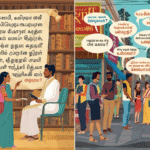

I grew up speaking Tamil, yet to this day I can’t make head or tail of the Tamil news on TV. So I finally sat down to understand why—and the answer turned out to be far more fascinating than I expected. I’ve tried to pull my research together as coherently as possible.
It turns out Tamil has one of the widest gaps between everyday speech and formal broadcast language among all major Indian languages. For a mix of historical, cultural, and practical reasons, Tamil almost feels like it’s living two parallel linguistic lives.
1. Tamil has an unusually strict formal / informal split
Every language has registers, sure. But Tamil takes this to vera levels. Spoken Tamil evolved naturally, trimming unnecessary endings, simplifying sounds, and adopting shortcuts. Just like every other living languages. But formal Tamil, especially the version used in news broadcasts, is modeled on classical literary Tamil, which is conservative by design. It keeps intact older grammar, longer word endings, purist vocabulary, and sentence structures that nobody uses.
2. Tamil purism movements created a “museum register”
Starting in the late 19th century and exploding in the mid-20th, Tamil had strong language-purism movements that pushed for:
- removal of Sanskrit-origin words,
- revival of pure Tamil words,
- respect for Sentamizh (classical Tamil),
- and a dignified, elevated style in public communication.
The result? The Tamil used in official settings started sounding like it was curated. Other Indian languages (e.g. Hindi, Bengali, Telugu) all have purist factions, yes—but none successfully shaped the broadcast standard the way Tamil purists did.
So the language on the 7 PM news is not just formal—it’s ideologically formal.
3. Tamil also has two different grammars: spoken vs written
Most languages have mild differences between spoken and written grammar. Tamil said, why be mild when you can be maximal?
So while spoken Tamil drops cases, collapses verb endings, merges sounds, deletes entire syllables and allows slang and English mixing, written/broadcast Tamil sticks to classical structures that are centuries old. For example:
- enna panre? → fully spoken
- neenga enna seidhu kondu irukkeergal? → broadcast Tamil
- nīṅka ēṉṟu ceytukoṇṭirukkīrkaḷ? → literary Tamil
Everyday Tamil and news Tamil almost feel like two related languages rather than two registers. I’m feeling better already!
4. Newsreader Tamil is trained performance, not natural speech
News anchors train in high enunciation, full pronunciation of every consonant, avoidance of slang, avoidance of region-specific markers and use of official vocabulary. So part of the schizophrenia I felt was because was simply that nobody speaks like that. It’s like if the Doordarshan National Hindi of Salma Sultan times became Bollywood Hindi’s only mode of communication.
The summary in one line
Tamil doesn’t just have formal and informal versions—it has an everyday living Tamil and a broadcast performative Tamil that’s inherited from classical norms and political language movements. That gap is why the Tamil News sounds like it’s speaking Tamil from another timeline.
What exactly is a “register”?
A register = the style or mode of language you use in a specific context.
Examples in English:
- “Bro, gimme two mins” → casual register
- “Dear Sir/Madam, I am writing to enquire…” → formal register
- “Initializing instance of class…” → technical register
A register is NOT about dialect or region. It’s about situation → formal, casual, technical, ceremonial, etc.
Audio-style spelling differences (how it sounds)
A. Everyday Chennai-ish colloquial
Loose, clipped, efficient.
- naa chaap-taa-chuh
- enna panre? → eh-na pan-ra
- varudhu → varudhu → often varu-duh
B. Neutral spoken Tamil (more “textbook” but still used by humans)
- naan saaptuten
- enna seira?
- mazhai vara irukku
C. Newsreader Tamil (hyper-formal)
Every syllable lands with full weight.
- naan saappittu irukkiren → naan saap-pi-tu iruk-ki-rEn
- neenga enna seidhu kondu irukkeergal → neen-ga en-na sei-dhu kon-du iruk-keer-gal
- mazhai peygiradhu → mazhai pey-gi-radhu