
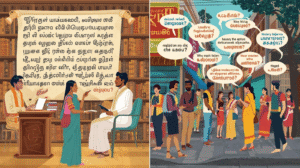
Tamil’s diglossia is so extreme that native speakers end up learning their own language in school the way others learn Latin — as a distant, classical, formal system, not the language of their daily life.
Why native Tamil speakers struggle with school Tamil (and Tamil News)
(And why it’s not their fault — the language is operating in multiple parallel universes.)
Tamil isn’t “diglossic” in the mild sense (like Hindi or Telugu). It’s hyper-diglossic—meaning the versions of the language used in different domains are so far apart that they behave like different dialects or even different languages sharing a script.
Linguists use a term called diglossia — when people use one type of a language for casual chatting and another type for serious, official stuff.
Most languages do this a little.
Tamil does it a lot.
What is diglossia?
A situation where a language has:
- an H (High) formal version → used in writing, speeches, news
- an L (Low) informal version → used in everyday conversation
Why Tamil is famous for it:
Tamil’s H and L forms differ so much in grammar, vocabulary, and sentence structure that they often feel like separate dialects of the same language.
- Tamil is one of the strongest examples of diglossia in the world.
- The gap between the High (H) variety (centamil / formal written Tamil) and the Low (L) varieties (spoken regional Tamils) is much larger than in Hindi, Telugu, Kannada, etc.
- The H and L varieties of Tamil are so structurally different that:
- They differ in syntax,
- morphology,
- lexicon,
- pronouns,
- verb conjugation,
- and even some permissible sentence structures.
Because of this, linguists often describe Tamil as a textbook case of “extreme diglossia.”
1. Tamil is Diglossia Level 9000
Most Indian languages have a gap between casual and school language. Tamil’s gap is uniquely extreme, because:
a) The formal written standard (Sentamil / செந்தமிழ்) is intentionally preserved as an ancient, pure form.
- It resists colloquial pronunciations
- It protects traditional grammar structures
- It avoids spoken contractions
- It uses vocabulary from classical sources
- It expects sandhi, tense markers, suffix stacking, purity rules
This “pure” Tamil comes with rules that people never use in daily speech. So learning Tamil grammar feels like learning a curated museum language.
b) Spoken Tamil is completely different structurally.
It has:
- Simplified grammar
- Reduced case endings
- Dropped particles
- Contracted verb forms
- Tons of borrowed words (Sanskrit, Urdu, English)
- Region-specific phonetics
- Caste/occupation-based slang layers
2. Spoken Tamil Has 5–6 Different Strongly Marked Registers
(1) Home Tamil
Relaxed, contracted, heavily region-coded.
(2) Street Tamil / Urban slang
Fast, English-mixed, highly compressed:
- panna → panra
- solla → solra
- vandhadhunaa → vandnaa
- irundhudhu → rindhudhu
(3) Brahmin Tamil
Sanskrit-heavy, Palakkad/Mylapore phonetics, ch→ss drift, melodic intonation.
(4) Non-Brahmin ‘Madras Bashai’
Street Creole Tamil with Telugu/Dakkhani influence.
(5) Formal Tamil (School essays)
Full classical grammar.
(6) Literary Tamil / Speech Tamil / News Tamil
A separate universe. No other Indian language maintains so many sharply distinct layers active at the same time in everyday life.
3. Tamil school grammar is basically “Classical Tamil Light”
Native speakers struggle because “school Tamil” isn’t the Tamil they speak.
| Everyday Tamil | School Tamil |
|---|---|
| naan ponaen | naan/se’n po’n’e’n / naan po’nen |
| ava vandhaa | aval vantaal |
| enakku theriyadhu | enakku theriyaadhu / enakku ariya villai |
| nee epdi irukka? | neengepadi irukki’reergal? |
Even verbs are different. Even pronouns are different. Even tenses follow different rules. It feels like English speakers suddenly being told to write assignments in Shakespearean grammar.
4. Tamil News is not formal spoken Tamil. It’s codified announcer Tamil.
The Tamil news reading style comes from:
- AIR (All India Radio) rules in the 1940s–60s
- Academy of Tamil guidelines
- Legacy oratory traditions
- Avoiding colloquial morphology
- Avoiding loan words
- Over-articulation of every character
So you get:
- Suspended sandhi rules
- Super-pure Sanskrit-avoidant vocabulary
- Very long compound words
- Slow, precise enunciation
- Rhythmic, heavily “trained” intonation
Even fluent Tamil speakers never hear this Tamil in real life.
A Chennai-born Tamilian can code-switch between home Tamil and street Tamil easily — but news Tamil is a different skill.
5. Why Tamil grammar feels extra tough
Tamil grammar as taught in schools is:
a) Case-heavy
Tamil has 8+ productive cases, and textbook Tamil expects students to identify:
- nominative
- accusative
- dative
- sociative
- instrumental
- locative
- ablative
- genitive
- vocative
…and their precise endings.
b) Agglutination-heavy
One verb can look like this:
padi–kka–vittu–ko–lla–p–pa–ttu–llaam
(study + cause + let + take + be + past passive participle + etc.)
Kids must split and label each morpheme.
c) Classical vocabulary is mandatory
Words no one uses in conversation show up on tests.
d) Meticulous sandhi rules
Which change phonetics unpredictably.
No one actually uses these rules in speech.
e) Syntactic order rules
Bend around literary conventions. Put simply: Tamil is a modern spoken language + a classical literary language living in parallel. School Tamil is the classical one.
6. Spoken Tamil evolves fast; written Tamil evolves slowly
Telugu, Kannada, and even Hindi updated school language to match daily speech over the last century.
Tamil deliberately preserved classical rigidity as a cultural project:
- To keep literary heritage intact
- To protect the identity of Tamil as one of the world’s oldest languages
- To avoid Dravidian identity being diluted by Sanskritized forms
The pride is justified — the cost is the difficulty.
So the gap continues.
7. So yes, even native Tamil kids find “School Tamil” hard
Tamil school exams feel like:
- Grammar drills from a language that isn’t spoken
- Vocabulary from 2000 years of literature
- Syntax that only appears in essays and speeches
- Rules no one uses at home
This makes Tamil itself feel:
- deep
- layered
- ancient
- internally diverse
- mentally “split”