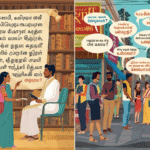
Yes, Thirukkural is one of the most celebrated works in Tamil literature. It’s an ancient Tamil text attributed to the poet-sage Thiruvalluvar, dating back over 2,000 years. The work comprises 1,330 couplets (the kurals), which cover various aspects of life, ethics, morality, and the values for a meaningful life. Yawn, nothing of this piqued my interest in school.
So, here’s the complete, no-nonsense, modern-person breakdown of the Thirukkural. I wear my marketing hat and will walk you through its structure, topics, intended target audience, worldview, and the “positioning strategy” behind it.
What is the Thirukkural, really?
The Thirukkural (or just Kural) is a 2,000-year-old, ultra-compressed life manual written in 1,330 verses. Each verse is just 7 words in two lines. Perfect for a tweet-length philosophy drop, yet dense enough to generate commentary for centuries.
It was written by Thiruvalluvar, whose life details are still mysterious. He is positioned more like a public intellectual + poet + ethicist rather than a court poet or priest. Think of him as a hybrid of Marcus Aurelius, Confucius, and a creative director.
1. How is the Thirukkural curriculum structured?
It has 3 major books. Each book is organized in chapters (adhikaram). Each chapter has exactly 10 couplets exploring a single theme. Each couplet is just 7 words in Tamil, yet packs profound meaning into this tight constraint. This isn’t accidental, Valluvar was working within the venba meter, a classical Tamil poetic form that demands both brevity and depth.
Book #1. Aram (Virtue / Ethics) – 38 chapters, 380 couplets
- Personal ethics
- Compassion
- Truth
- Non-violence
- Self-control
- Good conduct
- Duties of householders
- Duties of ascetics
- Social behaviour
Focus: What kind of person should you be?
Book #2. Porul (Wealth / Governance / Statecraft) – 70 chapters, 700 couplets
This came as a surprise because I assumed all “old” books were religious books or at least spiritual. The content here is pragmatic.
- Leadership
- Choosing ministers
- Diplomacy
- Espionage
- Military readiness
- Justice
- Economy
- Agriculture
- Ethical governance
Focus: How should a society function? How should leaders behave? How does a state thrive? This is Machiavelli-level analysis but with ethics baked in.
Book #3. Inbam (Love / Desire) 25 chapters, 250 couplets
- Falling in love
- Lovers’ quarrels
- Waiting
- Yearning
- Intimacy
- Separation
Focus: The emotional and erotic interiority of human relationships.
2. What topics does it cover?
The breadth is staggering. In Aram, you get everything from hospitality, compassion, and gratitude to controlling one’s speech and avoiding envy. Porul is essentially a comprehensive manual on statecraft and economics – it covers kingship, ministers, fortifications, army management, diplomacy, but also agriculture, wealth creation, and how to assess allies and enemies. Inbam explores romantic love with remarkable psychological insight – the anxieties of separation, the joy of union, the lover’s complaints.
There are two striking aspects: the books does not invoke a specific God, religion, or mythology. This makes the text super secular for its time. And its practical. For a poet-philosopher, he doesn’t wax abstract and instead gives practical advice.
3. Who was the target demographic?
This is the interesting part. It was not written for kings exclusively, like say Chanakya’s Arthashastra. It was not written for priests either, since it’s not ritual-based like the Vedas. It was written for any one caste/class, given how the tone is deliberately universal, intentionally accessible. Primary target audience:
- Ordinary people (yes, its ok to say ordinary people)
- Leaders
- Householders
- Poets, thinkers
- Young learners
- Merchants and community heads
- Anyone navigating society
4. What was the positioning (in modern marketing/branding terms)?
The Aram book applies to any moral person. The Porul book, while it discusses kingship extensively, also addresses citizens, merchants, farmers. The Inbam book speaks to universal human experiences of love. This univeral positioning was likely quite deliberate. Valluvar was positioning this as a text for Tamil civilization itself – a shared ethical and practical foundation that transcended caste, creed, and class.
5. What was the goal of the writings?
Purpose #1: To distill ethics into something universal
Thiruvalluvar wanted a system of values that any human could internalize, regardless of belief system.
Purpose #2: To give people a practical handbook to life
Real-world guidance. No philosophical fluff. Also you won’t find references to synergy in the kurals.
Purpose #3: To outline moral leadership
Instead of glorifying kingship, he wrote what good leaders must be. This was almost a political check: A king must behave like this—or he is not a king.
Purpose #4: To explore love and human emotion
Many ancient texts avoid the intimate emotional life. Kural centres it.
Purpose #5: To create a timeless, portable format
Short, poetic, easy to remember → fits the oral culture prevalent at those times.
If Thiruvalluvar were alive today, he’d pitch his book pilot as “The Ultimate Pocket Guide to Life: 1,330 Micro-Lessons”.
5. Author bio: was Thiruvalluvar a poet, academic, philosopher, or court writer?
He was fundamentally a poet-philosopher, deeply analytical and systematic. There is no reliable evidence linking him to a king’s commission, so definitely not a court poet. He does talk about virtue, destiny, and a “supreme being,” but never in sectarian terms. He is closest to a moral philosopher. Think Seneca / Confucius / Rumi (but secular) / Thoreau, with a Tamil poetic sensibility.
6. Why is it structured as Aram → Porul → Inbam?
This sequencing itself makes sense if you take a moment to think about it.
Aram → cultivate your character
Porul → participate in the world ethically
Inbam → manage the joy and chaos of relationships
The narrative arc goes from Self to Society to Love.
7. Modern interpretation: what makes the Thirukkural unique?
A. Secular spirituality
It’s moral but non-religious.
B. Minimalism
Every verse is a haiku-sized philosophy bomb.
C. Progressive ethics for its time (or maybe we’re too condescending in thinking less of our ancestors!)
- Anti-drinking
- Anti-cruelty
- Pro-kindness
- Anti-war unless unavoidable
- Pro-education
- Anti-corruption
- Respect for women
- Duties of good government
D. Deep psychological insight
Some couplets read like modern therapy, specifically cognitive behavioral therapy.
E. Soft power for ancient Tamil society
Tamil civilization “marketed itself” not through conquest but through ethics + literature. Thirukkural is the flagship product.
8. So what was the messaging and positioning?
Brand Strategy: A universal, secular, elegant rulebook for good living.
Tagline: How to be a good human—in 1,330 micro-lessons.
Value Proposition: Actionable ethics for everyone, from kings to commoners.
Tone: Minimal, poetic, authoritative, non-judgmental.